
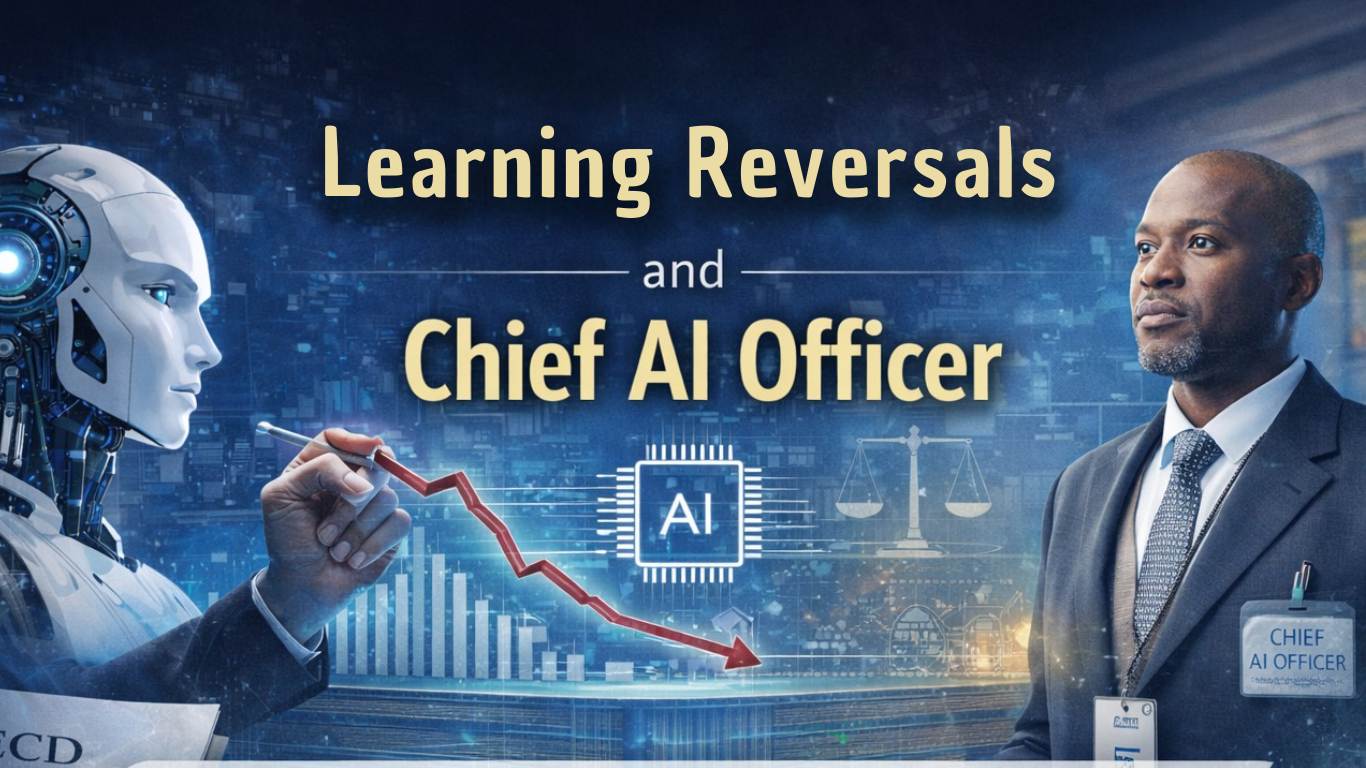
As we cross the mid-point of February 2026, the global higher education landscape has shifted from reactive panic to strategic operationalization. This week’s developments highlight a critical divergence: institutions that treat AI as a “bolt-on” utility are seeing declining learning gains, while those integrating AI as a “pedagogical partner” are reporting measurable improvements in student engagement and critical thinking. From the launch of the first dedicated open-access journals to the emergence of the “Chief AI Officer” as a standard executive role, the focus has moved squarely onto the “living evidence trail” of governance and the urgent need for standardized competency frameworks that protect human agency in an automated world.
The differentiator in 2026 is no longer whether students use AI—it is whether institutions can provide a governed environment that converts AI usage into durable intellectual fluency.
OECD Digital Education Outlook 2026: The “Learning Reversal” Warning
Summary
A landmark report from the OECD reveals that general-purpose AI tools are causing “learning reversals” when used without specific pedagogical design (OECD, 2026).
The Details
- Performance Drop: Data shows that while students using generic LLMs produce higher-quality initial assignments, their performance drops by up to 17% in exam settings compared to non-users.
- The Fix: In contrast, students using educational AI agents designed for “nudging” rather than answering showed a 48% improvement in sustained knowledge retention.
Why it Matters
This confirms that “cognitive offloading” is a systemic risk. Institutions must pivot from providing access to providing structured interventions that require active student effort.
The Rise of the Chief AI Officer (CAIO) in University Governance
Summary
New research published via EDUCAUSE identifies the Chief AI Officer (CAIO) role as the fastest-growing executive position in higher education for the 2025–2026 cycle (EDUCAUSE, 2026).
The Details
- Strategy Growth: Early CAIO incumbents report that 92% of institutions now have a work-related AI strategy, up from less than 50% two years ago.
- Core Focus: The role focuses on the “Five Lessons of AI Leadership,” balancing cloud-native infrastructure with civil-rights and privacy compliance.
Why it Matters
AI is moving from the “IT basement” to the Provost’s office. Governance is now an auditable requirement for federal funding and accreditation.
Policy & Governance
-
ASEAN Regional AI Readiness Findings
The first “AI Ready ASEAN” report reveals that while 83% of students use GenAI, fewer than 50% of faculty feel confident in their institution’s policy framework (ASEAN Foundation, 2026).
-
UNESCO Human Rights Framework for Digitalization
UNESCO has issued an urgent call to action, emphasizing that AI integration must not violate the “Right to Education” for the 40% of global schools still lacking basic internet connectivity (UNESCO, 2026).
-
The Shift to Auditable AI Governance
Accreditors in the US are now signaling that “documented governance”—who owns the decisions and how bias is monitored—will be a prerequisite for funding starting July 2026.
Programs, Research & Infrastructure
-
Launch of the International Journal of AI in Pedagogy
CSU San Bernardino launched a peer-reviewed, open-access forum focusing on building trust in degree credibility in the age of automation (CSUSB, 2026).
-
Cloud-First High-Performance Computing (HPC)
Institutions like RPI and ODU are pioneering “MonarchSphere” and “AiMOS” hubs to provide secure, governed compute models directly to students.
-
AI-Powered Adaptive Learning Systems
A systematic review of 73 studies confirms that AI-driven “scaffolded feedback loops” significantly improve student motivation in STEM and language courses.
Other: Writing & Literacy
-
Academic Integrity via “Hallucination Markers”
New research identifies seven key features professors use to detect AI-generated text, with “nonexistent sources” remaining the most reliable indicator (MDPI, 2026).
-
The “Cognitive Scaffold” Writing Model
A move toward “iterative drafting” models is replacing traditional take-home essays, requiring students to document the “Human-AI collaboration” process.
Do It Now Checklist
Betting on Governance and Mastery. This week’s briefing underscores that the focus in higher education has moved from the novelty of AI tools to the rigorous measurement of their impact on actual learning outcomes and institutional accountability.
With Inspiration Moments, we share motivational nuggets to empower you to make meaningful choices for a more fulfilling future. This week, we encourage you to move from “usage” to “mastery” by focusing on the “how” and “why” of technology integration. Stay mindful, stay focused, and remember that every great change starts with a single step. So, keep thriving, understanding that ‘Life happens for you, not to you, to live your purpose.’ Until next time.
Respectfully,
Lynn “Coach” Austin
References
All sources are hyperlinked in-text for immediate access to original publications.