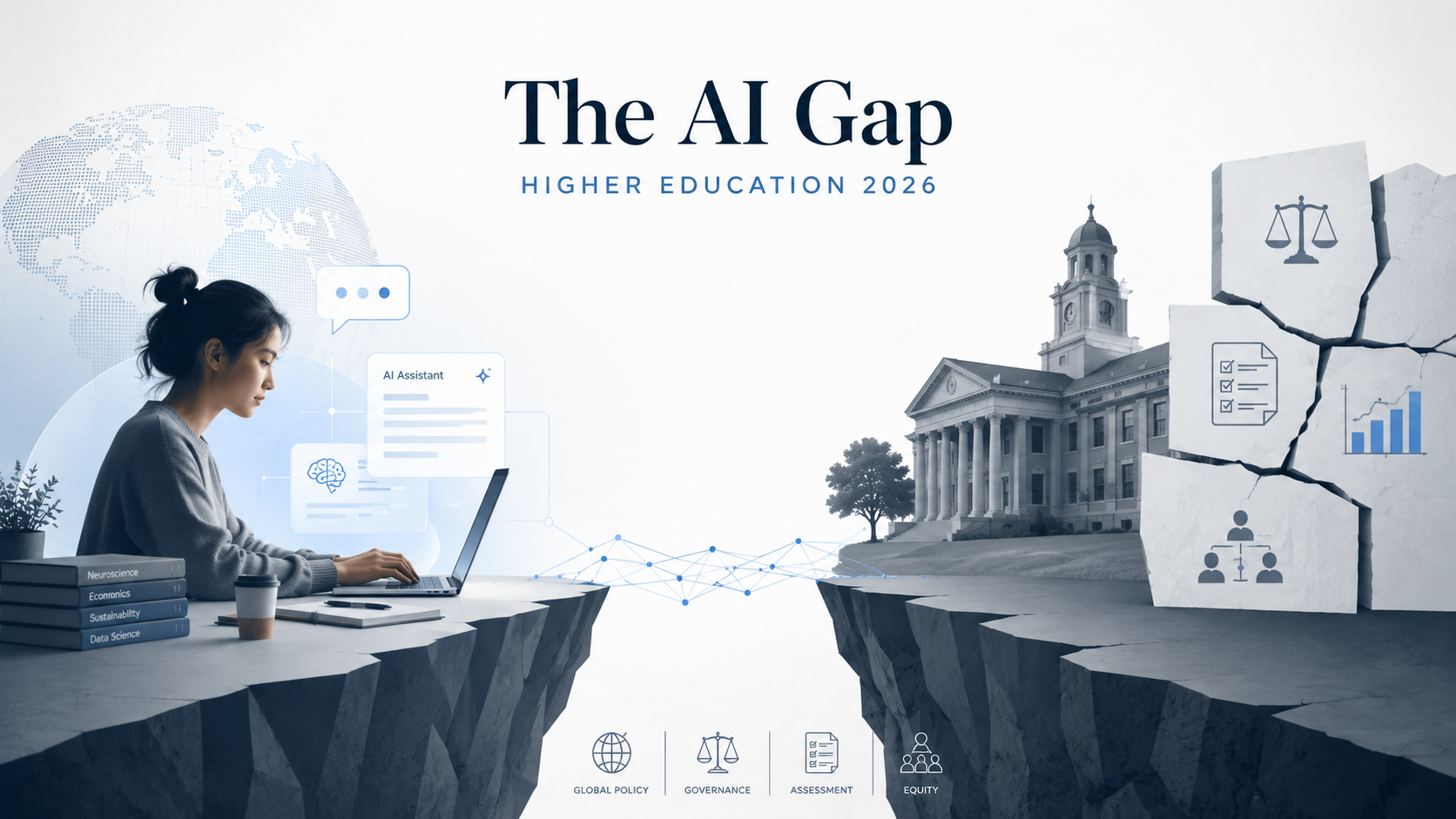
Higher education in 2026 is operating inside a polarized AI landscape. Students have absorbed generative AI into daily academic practice with extraordinary speed, while institutions remain inconsistent, under-resourced, and largely reactive. This week’s brief brings together five developments that, read as a whole, define that polarization: AAC&U’s AI Week, HEPI’s landmark 2026 student survey, ETS’s first AI-based teacher assessment tool, UNESCO IESALC’s Latin America observatory launch, and a sharpening equity dimension inside AI adoption itself.
“The gap is no longer between institutions that use AI and those that don’t — it is between students who have already integrated it and institutions still deciding whether to.”
— Lynn F. Austin, MBA
The Student Surge: HEPI’s 2026 Baseline
HEPI’s 2026 student survey does something earlier surveys could only gesture toward: it establishes student AI use as baseline practice rather than emerging behavior. The implication for institutional leaders is structural, not rhetorical. Policy frameworks built on the assumption that AI use is a minority behavior to be discouraged or contained are now misaligned with the reality of the classroom. The sharper-than-expected sub-finding is the equity dimension — access to premium AI tools is uneven within student cohorts in ways institutions are not yet measuring.
- Adoption ubiquity: AI use is now normalized across cohorts, not concentrated in a tech-forward minority.
- Disciplinary variation: Patterns of use differ sharply by field, making blanket institutional policy increasingly untenable.
- The equity dimension: Premium-tool access is emerging as a within-cohort divide that mirrors and amplifies existing inequalities.
Sector Mobilization: AAC&U AI Week and the ETS Signal
AAC&U’s elevation of AI to an organizing theme for AI Week marks a turning point. AI is no longer a breakout track at generalist higher-ed convenings — it has become the connective tissue across pedagogy, assessment, equity, and credentialing conversations. ETS’s release of its first AI-based teacher assessment tool sends a complementary signal from the evaluation side: AI is being built into the infrastructure of assessment itself, not merely the surface of instruction.
Together, these moves indicate that institutional response is finally scaling. The warning is that scale without coherence produces patchwork. Without shared frameworks linking adoption, governance, and equity, institutions risk accumulating AI initiatives that do not add up to a strategy.
Policy & Governance: Global Responses
UNESCO IESALC Latin America Observatory
Establishes regional AI policy infrastructure as a permanent multilateral fixture with locally specific framing.
HEPI Risk Framework
Shifts the institutional conversation from individual tools to durable governance pillars and accountability.
The Equity Frontier
Disparity in premium AI tool access is now a policy question, not just a research finding.
Institutional Strategy & Innovation
AAC&U AI Week
Signals AI as a sector-level organizing theme, not a peripheral or specialist concern.
ETS Teacher Assessment
Evaluation infrastructure itself is being reshaped by AI, with implications for accreditation and quality.
Equity Audits
Early-mover institutions are formally auditing AI access disparities before they harden into outcome gaps.
The Human Element: Faculty Voice
Faculty are caught in the gap. They are being asked to enforce policies that have not yet been written, and to prepare students for workforces being rewritten in real time. The argument many faculty are making is not that institutions are moving too fast or too slow — it is that institutions are moving without them. Bringing faculty into policy design, rather than informing them after the fact, is the difference between credibility and compliance theater.
Institutional Action Checklist
- ✅ Quantify Your Gap: Measure local student adoption against the emerging national baseline.
- ✅ Audit AI Access Equity: Surface within-cohort disparities in premium tool access.
- ✅ Move from Prohibition to Specification: Build discipline-specific guidance, not blanket bans.
- ✅ Bring Faculty into Policy Design: Before policy is finalized, not after it is announced.
- ✅ Anchor to Sector Frameworks: Align with AAC&U, UNESCO, and HEPI to avoid building in isolation.
Join the Conversation
Is your institution closing the gap between student practice and institutional readiness — or watching it widen? Share your perspective.
Betting on Alignment
The institutions leading 2026 will not be those with the most ambitious AI strategy on paper. They will be those whose strategy actually matches the practice of their students, the constraints of their faculty, and the standards of the workforce they serve. Polarization is a window, not a permanent state — and the window is narrowing. Every great change begins with a single step toward honesty. Stay mindful, stay focused, and remember: life happens for you, to live your purpose. Until next time.
Respectfully,
Lynn “Coach” Austin