
Fresh off finishing my doctorate and busier than ever, I said yes to my first faculty PD summit presentation anyway. Here’s what that decision, and C-Man and Sir Claude a-lot, taught me about the judgment AI still can’t do for us.
As faculty prepare for a new academic year, higher education is retiring AI detectors and facing a harder question: how to prove students actually learned. This edition covers the shift from detection to evidence of learning, OpenAI’s new role-specific education plugins, and the widening gap between AI adoption and governance.
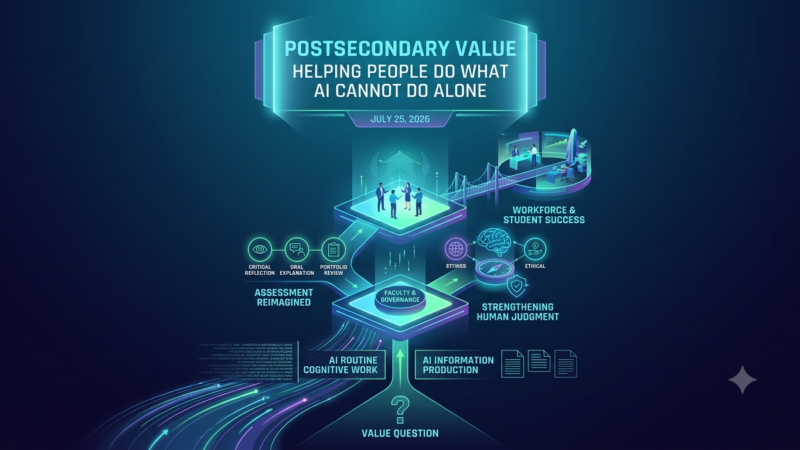
Two tensions defined the week in higher education and AI: a sharpening question about what a degree is worth, and a widening gap between AI access and the governance, faculty preparation, and assessment design needed to use it well. This edition covers the Ithaka S+R value brief, a 156,135-student study on AI and grades, and new AI degree programs from Chicago to South Dakota.
The era of AI experimentation in higher education is over. The conversation now is about ROI. This week’s brief looks at why institutions are shifting to enterprise-wide metrics, how AI pedagogical agents are increasing STEM retention by 14 percent, and what the new EDUCAUSE framework means for campus strategy.
AI didn’t create the assignment problem in higher education—it revealed it. A practical framework for faculty to redesign coursework around judgment, accountability, and visible thinking in an AI-shaped academic environment.
Higher education is living in a polarized AI landscape — students have embraced AI at extraordinary speed while institutions remain inconsistent, under-resourced, and reactive. This week’s brief captures AAC&U’s AI Week, HEPI’s landmark 2026 student survey, ETS’s first AI teacher assessment tool, UNESCO’s Latin America observatory launch, and a striking new equity dimension in AI adoption.
Higher education’s AI conversation is shifting from frantic adoption and surveillance toward governance, faculty development, and human-centered design. This week’s global evidence—from a 30,000-respondent LATAM survey to a major ethics synthesis—maps what accountable integration now requires.