A practical way to redesign assignments around judgment, accountability, and learning.
A student submits a polished paper. The formatting is clean. The grammar is strong. The citations look reasonable. The argument moves from point to point with no obvious gaps.
And still, something feels missing.
Many faculty know that moment now. The work is complete, but the student’s thinking is hard to find. That is the real challenge AI has posed to higher education. Not simply whether students used a tool, but whether the assignment still gives us evidence of learning.
For the past two years, much of the conversation has centered on detection. Did the student use AI? Can we prove it? Should we ban it? Those questions are understandable, but they are no longer enough. The more useful question is this: what does this assignment actually require the student to think through?
If the answer is “not much,” AI did not create the problem. It revealed it.
As both a faculty member and doctoral researcher studying AI workforce readiness, I see this issue as larger than academic integrity. It is about whether our courses are still developing the judgment students will need in AI-shaped workplaces.
The Shift from Output to Judgment
For years, many assignments have been evaluated primarily through outputs: papers, problem sets, presentations, reflections, and projects. AI disrupts this because it makes those outputs easier to produce.
But the output was never supposed to be the only goal.
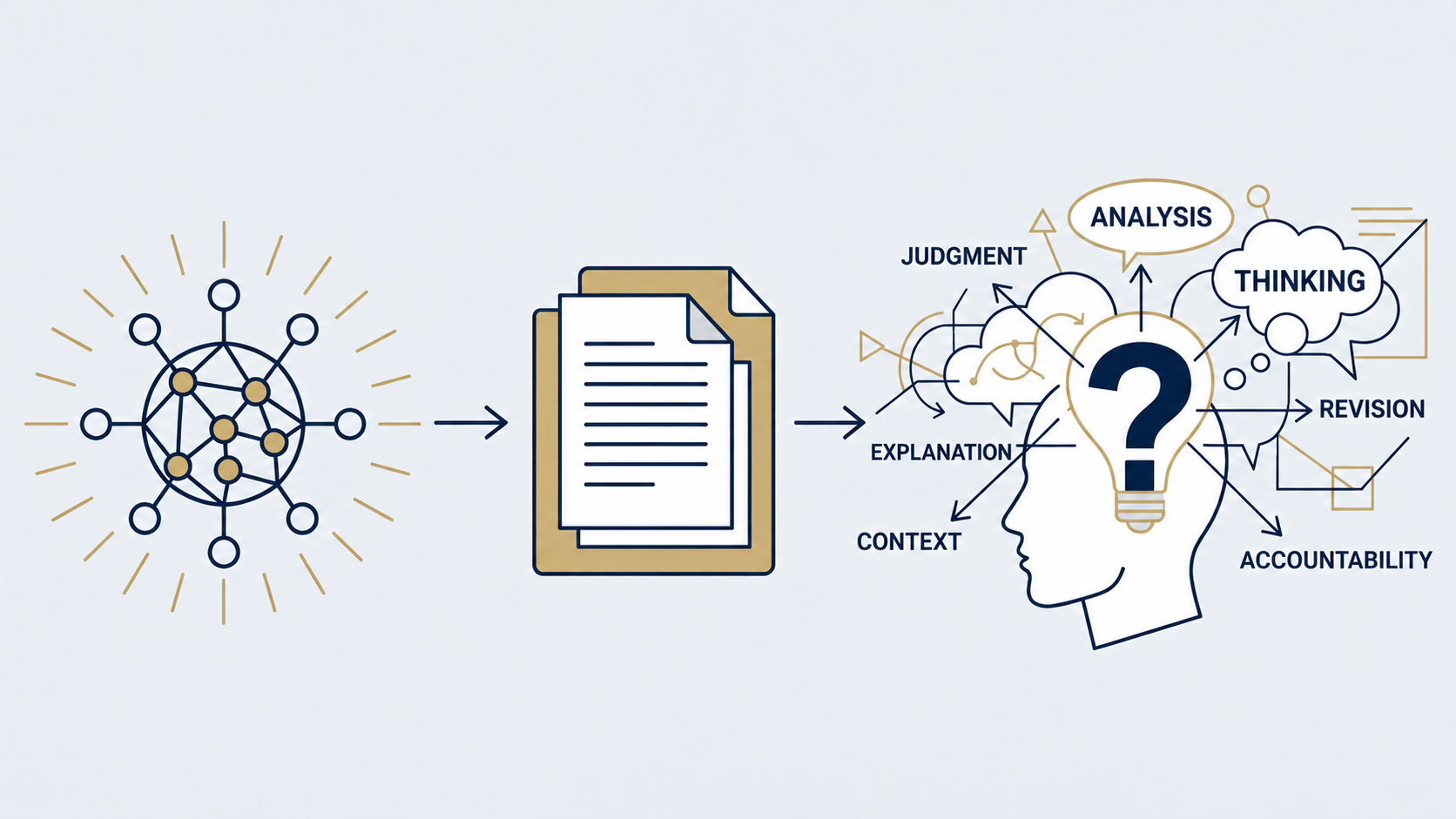
The real goal was learning. More specifically, the goal was for students to analyze, compare, decide, revise, explain, and take responsibility for the quality of their work. In other words, the goal was judgment.
AI can generate, compare, summarize, and even critique answers. What it does not carry is human responsibility for the decision. Students still need to learn how to evaluate quality, apply context, recognize limits, explain trade-offs, and stand behind what they submit.
That means the task before the faculty is not simply to make assignments AI-proof. That may not be realistic. The better task is to make students’ thinking more visible.
What the Research Is Pointing Toward
The pressure faculty feel is not imagined. Sector surveys describe AI moving quickly across higher education while many institutions are still catching up on strategy, policy, and readiness (Robert & McCormack, 2025). That gap does not stay in the provost’s office. It lands in the classroom, on the assignment, in the grading.
Recent research on AI and assessment points toward a clear response. Bearman et al. (2024) argue that students need to develop evaluative judgment in relation to AI outputs, AI processes, and their own decision-making. That matters because students will not only be asked to use AI in future workplaces. They will be asked to decide whether the work AI produces is accurate, ethical, useful, and appropriate for the situation.
Research on authentic assessment also complicates a common faculty assumption. We sometimes believe that authentic or applied assignments are automatically safer from AI misuse because they are more realistic. Kofinas et al. (2025) challenge that assumption by showing that generative AI can still produce work that appears credible in higher education assessment settings. Authenticity matters, but it is not enough by itself.
The issue, then, is not whether faculty should abandon traditional assignments overnight. The issue is whether assignments still require students to demonstrate the thinking behind the work.
What This Looks Like in Practice
Faculty do not need to redesign an entire course to begin responding well. Often, the best place to start is with one assignment.
Consider a traditional prompt:
There is nothing obviously wrong with this prompt. It asks for content knowledge, application, and research. But in an AI environment, a student can enter that prompt into a tool and receive a clean, passable response in seconds.
Now consider a revised version:
Write a three-page paper explaining the ethical responsibilities of a business using one course concept and two outside sources. Then add a 250-word decision note explaining:
- the hardest judgment you made while writing,
- one place where your first answer was too simple,
- how one course concept changed or challenged your thinking, and
- what you would still need to know before making a real business recommendation.
The revised prompt does not ban AI. It does something more useful. It asks the student to show judgment.
That added decision note changes the nature of the assignment. The student must explain how they thought, where they struggled, what they reconsidered, and what they still do not know. Those are much harder to fake well because they require engagement with the course, the task, and the student’s own reasoning.
This shift has a name in the assessment literature. Frameworks like the AI Assessment Scale move faculty away from a single allow-or-ban decision toward defined levels of permitted AI use, so the expectations are explicit for both the student and the instructor (Perkins et al., 2025).
Four Ways to Make Thinking Visible
There are several simple ways faculty can redesign assignments without starting over.
First, ask students to explain a decision. Add one question to an existing assignment: “What was the hardest decision you made in completing this work, and where does that decision show up in what you submitted?” Students who engaged with the material will usually have something specific to say. Students who only pasted in a response may struggle to answer with clarity.
Second, ask students to compare the AI output to the course material. Have them run a course-related question through an AI tool, then compare the response to a reading, lecture, class discussion, case, or field example. Where do the sources agree? Where do they diverge? Which answer is stronger, and why? This helps students practice the evaluative judgment they will need beyond the classroom.
Third, require iteration, not just a final product. A polished final draft tells faculty little about how the student arrived there. A brief sequence of notes, outlines, revisions, and reflection gives a clearer picture of thinking in motion. It also makes superficial use of AI easier to spot because students must account for how the work has changed.
Fourth, anchor prompts to the specific. AI is weakest when the task depends on a particular class discussion, a local example, a personal observation, a course case, a workplace scenario, or a recent learning moment that is not easily retrieved from a general database. The more the assignment depends on what happened inside the course, the more it requires the student to actually be present in the learning process.
The 4R Assignment Test
One practical way to review an assignment is to use what I call the 4R Assignment Test.
The 4R Assignment Test
Reasoning. What must the student explain, compare, justify, or decide?
Revision. Where must the student show improvement, reconsideration, or a change in thinking?
Responsibility. What part of the work must the student own, defend, or verify?
Relevance. How does the assignment connect to course material, lived experience, field practice, a current issue, or a specific case?
If an assignment does not require at least one of these, it may be too easy for students to complete without meaningful engagement. If it includes two or more, the assignment is more likely to reveal learning rather than just a finished product.
This is not about making every assignment longer. It is about making the right part of the assignment visible.
What Students Need to Develop
These changes are not only about managing AI. They are about clarifying what we want students to learn.
Students need to understand how AI tools generate responses and where those responses can fail. They need to know that fluency is not the same as accuracy. They need to recognize that a confident answer can still be incomplete, biased, outdated, or wrong.
They also need to understand accountability. If students submit work with AI assistance, they are still responsible for what they turn in. The tool does not attend class. The tool does not know the student’s purpose. The tool does not bear the consequence of a poor judgment.
That means students need practice asking better questions, checking sources, explaining their choices, and revising weak reasoning. These are not side skills. They are the skills students will need in workplaces where AI tools are already becoming part of daily practice.
The Question Worth Sitting With
The faculty who navigate this moment well will not necessarily be the ones who find the best detection tool. They will be the ones who ask a harder and more useful question:
If a student handed this prompt to AI and submitted what came back, what would they have actually learned?
That question may be uncomfortable, but it is one of the most useful design tools faculty have right now.
Start with one assignment this week. Look at the prompt. Look at the grading criteria. Then ask yourself: Where does the student’s thinking actually show up?
If the answer is unclear, revise one part of the assignment. Add a decision note. Require a comparison. Ask for a revision explanation. Connect the work to a specific course moment. Make students show not only what they produced, but how they judged, questioned, revised, and took responsibility for it.
AI can write the paper.
The real question is whether the student can defend the thinking.
Respectfully,
Lynn “Coach” Austin
References
Bearman, M., Tai, J., Dawson, P., Boud, D., & Ajjawi, R. (2024). Developing evaluative judgement for a time of generative artificial intelligence. Assessment & Evaluation in Higher Education, 49(6), 893–905. https://doi.org/10.1080/02602938.2024.2335321
Kofinas, A. K., Tsay, C. H., & Pike, D. (2025). The impact of generative AI on academic integrity of authentic assessments within a higher education context. British Journal of Educational Technology, 56(6), 2522–2549. https://doi.org/10.1111/bjet.13585
Perkins, M., Jasper, R., & Furze, L. (2025). Reimagining the Artificial Intelligence Assessment Scale: A refined framework for educational assessment. Journal of University Teaching and Learning Practice, 22(7). https://doi.org/10.53761/rrm4y757
Robert, J., & McCormack, M. (2025, February 17). 2025 EDUCAUSE AI Landscape Study: Into the Digital AI Divide. eric.ed.gov (ED678854)