

Higher education is crossing from informal AI use into formal academic obligation. Institutions are no longer experimenting quietly. They are setting graduation requirements, redesigning assessment practices, and automating long-standing administrative decisions. These moves elevate artificial intelligence from a teaching tool to a governance matter with direct implications for faculty authority, curriculum control, and academic standards. This week’s stories show institutions taking decisive action, while exposing where governance and faculty engagement still lag behind the pace of change.

Purdue University Makes AI Competency a Graduation Requirement
Summary
Purdue University has taken one of the clearest institutional positions to date by formally tying AI competency to undergraduate graduation, signaling a shift from optional exposure to academic obligation.
The Details
The Purdue Board of Trustees approved a comprehensive AI strategy covering instruction, research, operations, and external partnerships. Beginning in 2026, all undergraduates must demonstrate discipline-specific AI working competency. Colleges and departments are responsible for defining learning outcomes, instructional approaches, and assessment standards, with early resources rolled out ahead of full implementation
(Purdue University, 2025).
Why It Matters
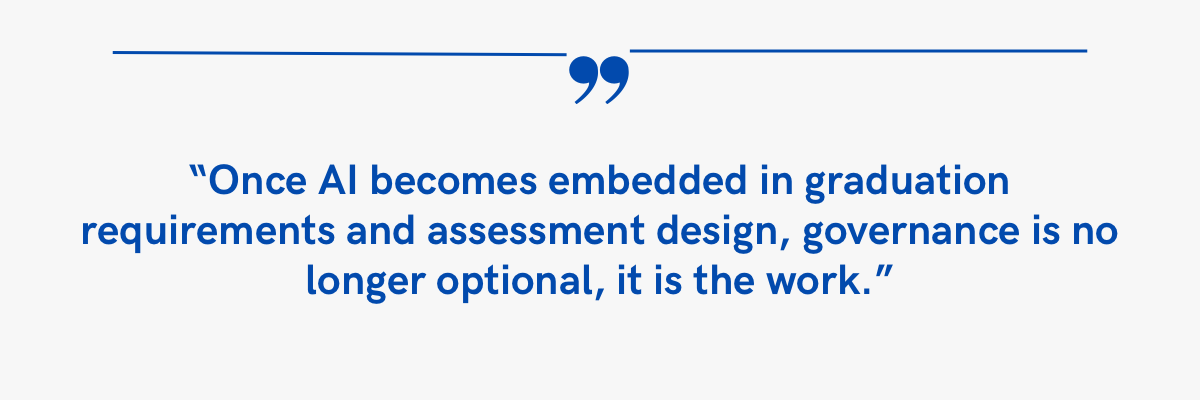
This decision shifts AI from optional exposure to an academic requirement. Faculty are now responsible for defining what competent, ethical AI use looks like within their disciplines. Institutions that do not clarify governance authority, workload expectations, and assessment ownership risk uneven execution and faculty pushback.
AI-Based Transfer Credit Evaluation Expands Across U.S. Campuses
Summary
Artificial intelligence is being applied to one of higher education’s most persistent structural challenges: transfer credit evaluation.
The Details
An AI tool developed at the University of California, Berkeley is being piloted at approximately 120 institutions. The system analyzes course content and institutional criteria to recommend transfer equivalencies, aiming to reduce processing delays and improve transparency for students navigating multi-institution pathways
(Government Technology, 2025).
Why It Matters
Transfer students are often adult learners and first-generation students. Applying AI here affects access, equity, and completion. Governance clarity is essential to ensure academic standards are preserved rather than silently automated away.

Policy & Governance
-
-
UNESCO Reports Widespread Development of AI Guidance
A global UNESCO survey finds that nearly two-thirds of higher education institutions affiliated with its networks now have, or are actively developing, formal guidance on AI use in teaching, research, and assessment
(UNESCO, 2025). -
Faculty Still Marginalized in Institutional AI Decisions
Recent reporting indicates that AI platform adoption and policy decisions are frequently led by senior administrators or vendors, with limited involvement from faculty governance bodies
(Inside Higher Ed,
-

Programs, Research & Infrastructure
-
Oral Examinations Re-Emerge as an AI-Resilient Assessment Strategy
Colleges are reintroducing oral examinations to assess student understanding and reduce inappropriate use of generative AI, with early evidence pointing to stronger engagement and clearer demonstrations of learning
(Washington Post, 2025).

Betting on Faculty Authority
Higher education is moving into a phase where AI decisions shape academic identity, not just efficiency. Institutions that anchor AI use in faculty authority, transparent governance, and intentional assessment design will hold their footing. Those that defer decisions or outsource judgment will struggle to regain trust and control.
Betting on faculty authority means choosing academic stewardship before institutional momentum makes the choice for you.
Through our Inspiration Moments, we provide coaching and guidance to help educators and leaders make informed, values-driven choices that strengthen teaching, governance, and institutional trust in the age of A I. Stay mindful, stay focused, and remember that every great change starts with a single step. So, keep thriving, understanding that “Life happens for you, not to you, to live your purpose.” Until next time.
Respectfully,
Lynn “Coach” Austin
References
All sources are hyperlinked in-text for immediate access to original publications.
 Listen to the Podcast