
This week marks a definitive shift from ad-hoc tool adoption to robust institutional infrastructure and governance. The headlines are dominated by massive investments in “sovereign AI compute” and the establishment of dedicated centers for responsible AI governance, signaling that higher education is moving into a phase of maturing strategy. From Northeastern’s industry-aligned governance center to the University of Toronto’s federally backed supercomputing upgrade, universities are building the physical and ethical backbones necessary to support the next generation of AI research and teaching. Simultaneously, the debate over curriculum integration intensifies, with major US institutions grappling with how to embed AI without eroding foundational critical thinking skills.
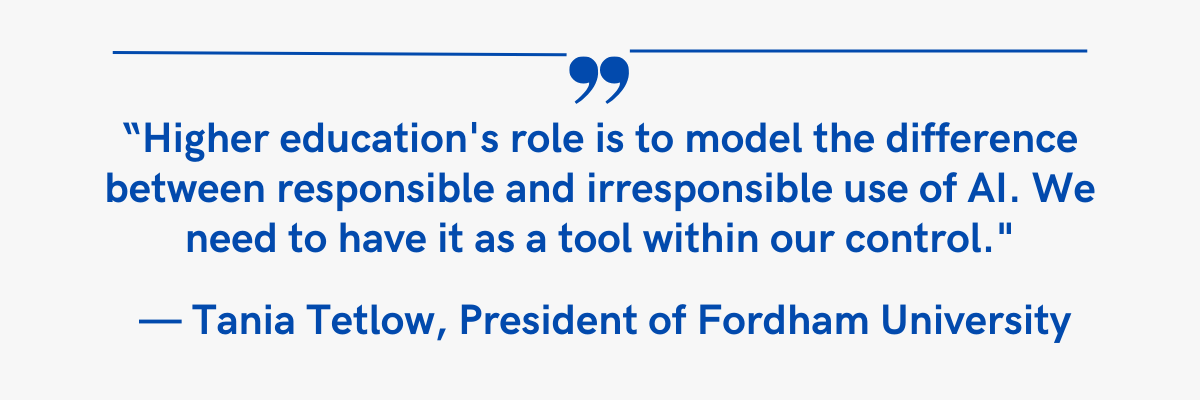

Northeastern University Launches Center for Responsible AI and Governance (CRAIG)
Summary
Northeastern University has established the Center for Responsible Artificial Intelligence and Governance, a first-of-its-kind NSF-funded initiative uniting academic rigor with industry expertise to address ethical issues including privacy, regulation, and siloed decision-making (Mello-Klein, 2025).
The Details
- Led by Associate Professor John Basl with industry partners including Meta.
- Tackles real-world ethical problems companies lack infrastructure to address.
- Moves institutions beyond basic compliance toward responsible innovation.
- Research includes technical privacy questions and broader regulatory frameworks.
Why It Matters
CRAIG signals a proactive governance model where universities lead the AI ethics conversation rather than reacting to it. The structure offers a blueprint for how higher education can shape global standards.
University of Toronto Receives $42.5M for Sovereign AI Compute Infrastructure
Summary
The University of Toronto received a $42.5 million federal investment to expand high-performance AI compute capacity under Canada’s “Sovereign AI Compute Strategy,” supporting research in health care, engineering, and the humanities (Kalvapalle, 2025).
The Details
- Funded through the Digital Research Alliance of Canada’s National AI Compute initiative.
- Builds on a previous $52 million upgrade to the SciNet supercomputer.
- Aims to reduce reliance on foreign infrastructure and strengthen national capability.
- Designed for nationwide accessibility across Canadian research institutions.
Why It Matters
Compute access now defines research competitiveness. This investment highlights that AI readiness requires industrial-grade capacity, not just software, ensuring faculty can compete globally.

Policy & Governance
-
US Dept of Education Prioritizes AI in $50M FIPSE Grant Competition
Federal Funding Priorities — The Department of Education has released a new solicitation for the Fund for the Improvement of Postsecondary Education (FIPSE), explicitly naming the “expansion of AI understanding and use” as an absolute priority for $50 million in new awards (U.S. Department of Education, 2025).
-
University of Utah Launches ChatGPT Edu for Campus-Wide Use
Secure, Private Access — Moving beyond patchwork adoption, the University of Utah has officially deployed “ChatGPT Edu,” a secure, enterprise-grade version of the tool designed to protect university data while giving students and faculty access to advanced GPT-4o capabilities (University of Utah, 2025).
-
Wyoming Universities Link with National Labs for “Genesis Mission”
Energy & AI Research — The University of Wyoming is joining a new federal initiative dubbed the “Genesis Mission,” which links national laboratories with university researchers to use AI and supercomputing for breakthroughs in energy and nuclear innovation (Cowboy State Daily, 2025).

Programs, Research & Infrastructure
-
Debate Heats Up: Does AI Integration Erode Critical Thinking?
Curriculum Design Tension — A new report highlights growing friction at institutions like Ohio State and the University of Florida, where broad mandates to embed AI into undergraduate degrees are clashing with research suggesting that heavy AI reliance may reduce student brain activity and reasoning skills (Times of India, 2025).
-
Bennett University Global AI Summit Sets Research Agenda
International Collaboration — Bennett University’s recent summit brought together global academic leaders and industry giants like Microsoft to define a “blueprint” for AI research, showcasing over 100 student projects and emphasizing cross-border university partnerships (Times of India, 2025).

Other News
-
UNESCO IITE Launches “Teach and Learn with AI” Courses
Global Faculty Development — UNESCO has rolled out new online courses aimed at empowering educators to use GenAI for pedagogical enhancement, focusing on creating criterion-based rubrics and personalized feedback mechanisms (UNESCO, 2025).
-
TeachBetter.ai Releases Version 3.0 with Multimodal Tools
EdTech Tool Update — The AI platform TeachBetter.ai has released a major update featuring over 20 new tools for educators, including an instant presentation generator and interactive STEM simulations, aiming to save teachers 5–10 hours of prep time weekly (ANI News, 2025).

Do It Now Checklist
Betting on Responsible Infrastructure
This issue makes one point unmistakable: higher education is stepping into a season where good intentions are no longer enough. Institutions are being asked to prove they can govern A I, not just deploy it. From federally funded oversight centers to sovereign compute investments and rising tension around curriculum design, the campuses that will hold their footing are the ones willing to build the ethical and physical foundations that responsible A I requires. The work is heavier, but it is also clearer, and it is pushing higher education toward a more deliberate future.
With Inspiration Moments, we share motivational nuggets to empower you to make meaningful choices for a more fulfilling future. This week, we focus on building the ethical and physical foundations for A I. Stay mindful, stay focused, and remember that every great change starts with a single step. So, keep thriving, understanding that “Life happens for you, not to you, to live your purpose.” Until next time.
Respectfully,
Lynn “Coach” Austin
References
All sources are hyperlinked in-text for immediate access to original publications.