
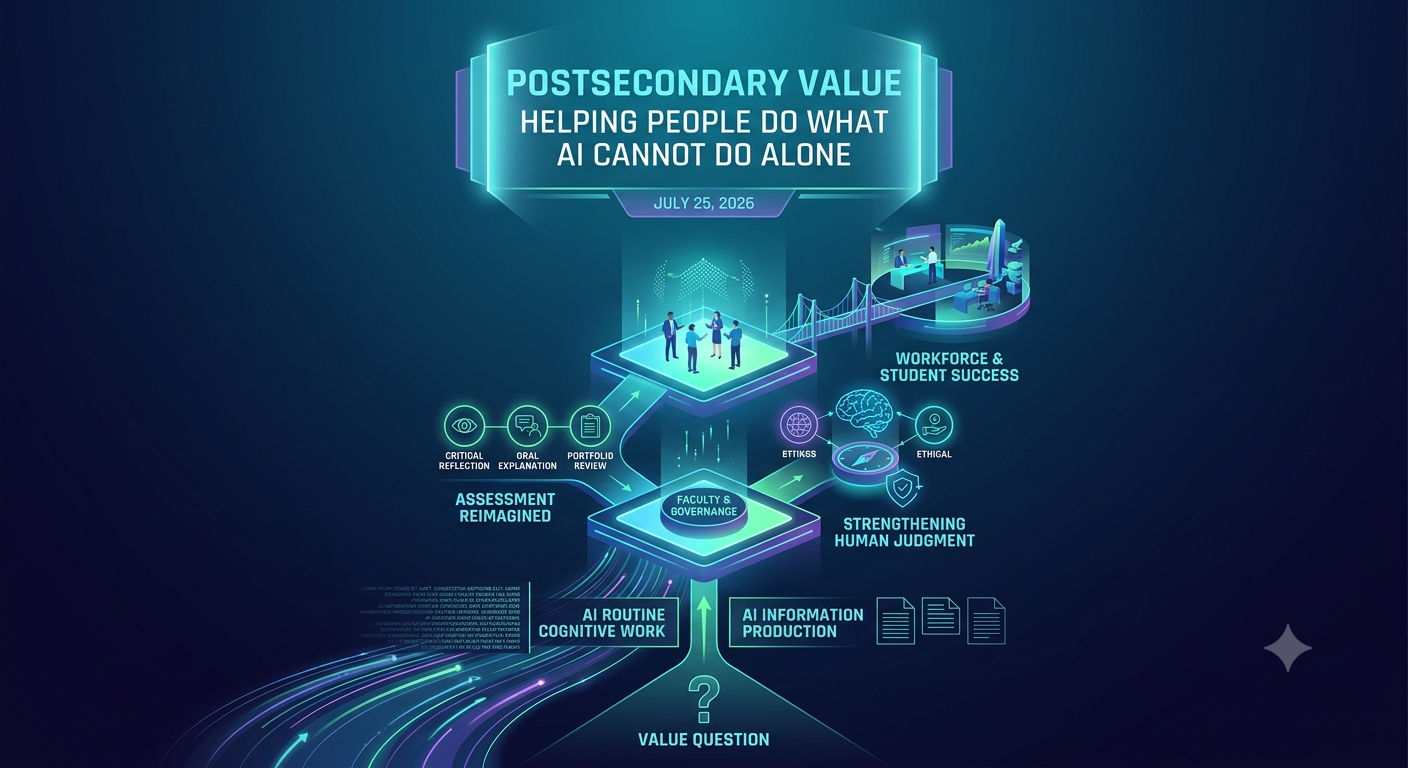
The week’s signals converge on a question institutions can no longer defer: what is a degree worth when AI can produce information, draft content, and finish routine cognitive work in seconds? Two tensions sharpen it. The first is a value problem, as colleges are asked to name what students gain that AI-assisted self-study cannot deliver. The second is an implementation gap, as access to AI tools expands faster than the governance, faculty preparation, and assessment design needed to use them well. The next phase of this work will not be settled by who has the tools. It will be settled by whether institutions can protect credible learning, strengthen human judgment, and connect AI strategy to student success and workforce value.
“Higher education cannot win an argument about speed. Its case rests on the judgment, knowledge, and human relationships that speed will never replace.”
— Dr. Lynn Austin
AI Is Now a Question About What a Degree Is Worth
The Details
A new Ithaka S+R issue brief from Martin Kurzweil argues that AI is pressing on nearly every assumption behind postsecondary value: what students should learn, how institutions operate, how research is conducted, and how knowledge is produced and trusted. The concern reaches past the classroom to the basic purpose and affordability of higher education (Kurzweil, 2026). The brief names immediate needs in AI literacy, assessment redesign, operational workflows, research methods, and information integrity, alongside a harder question: which forms of human judgment become more valuable when routine cognitive work is automated.
Why it Matters
Faculty and academic leaders need to say plainly how a course builds knowledge, judgment, and professional capability, not simply how it delivers information. That means tying AI governance decisions to learning quality, student outcomes, mission, and affordability. A strategy built only around tools will miss the question families are already asking: what is college for in an AI-enabled world?
A Study of 156,135 Students Finds No AI Grade-Inflation Effect
The Details
Researchers analyzing 156,135 students and 87,936 course offerings at a large U.S. university from 2015 to 2025 found no significant evidence that the availability of generative AI raised grades in courses considered more vulnerable to AI assistance, and no consistent decline in students’ self-reported understanding of the material (Dumlao et al., 2026). Using a differences-in-differences design, the team compared courses that lean on take-home essays and problem sets against those built on in-class examinations, before and after ChatGPT’s release, while accounting for pandemic effects.
Why it Matters
The finding does not prove AI has no effect on individual assignments, and faculty should still redesign vulnerable assessments and require visible evidence of student thinking. It does caution leaders against treating aggregate grade changes as proof of widespread misconduct. Responsible governance means interpreting data carefully, reviewing assessments by discipline, and recognizing that AI’s effects will differ across courses and student populations.
Policy & Governance
-
Implementation Becomes an Institutional Discipline, Not an Experiment
UPCEA’s six-week AI study groups found campus conversations shifting from experimentation toward roadmaps, change management, student support, faculty development, privacy, procurement, cybersecurity, and governance. Participants stressed that AI implementation is primarily a leadership and organizational challenge, not simply a technology project (Cook et al., 2026).
-
Assessment Reform Should Replace Detection-First Thinking
The African Population and Health Research Center argues that generative AI has exposed long-standing weaknesses in take-home essays and conventional assessment. Its analysis warns that detection tools can produce unreliable and inequitable results, particularly for multilingual and neurodivergent students, and recommends verifying learning through drafts, reflection, oral explanation, and personal engagement (African Population and Health Research Center, 2026).
-
Aspen University Adopts a Human-Centered AI Position
Aspen University issued a formal position connecting AI use to student success, academic quality, workforce preparation, transparency, and human judgment, stating that AI should support rather than replace faculty, advisors, staff, academic leaders, or student effort (Aspen University, 2026).
Programs, Research & Infrastructure
-
Ohio State Extends AI Fluency Across Disciplines
Ohio State advanced its university-wide AI Fluency initiative through college-level roadmaps, faculty support, and classroom resources, and convened faculty through its Joint Human-AI Systems Idea Lab to examine collaborative research across human and artificial intelligence systems (The Ohio State University, 2026).
-
Alabama Connects AI Curriculum to Employer Expectations
Auburn University hosted the Alabama Higher Education AI Exchange, drawing approximately 350 faculty members, career-services professionals, public officials, and industry representatives to examine how AI is changing job roles, curriculum, and the relationship between classrooms and workforce needs (Auburn University, 2026).
-
Northeastern Illinois Opens an Accessible AI Bachelor’s Degree
Northeastern Illinois University announced a Bachelor of Science in Artificial Intelligence beginning fall 2026, becoming the first public university in Chicago to offer an undergraduate AI degree. The curriculum spans programming, mathematics, machine learning, natural language processing, software engineering, and ethical AI development, with no prior experience required to enter (Northeastern Illinois University, 2026).
-
South Dakota State Builds an AI Engineering Ladder From Bachelor’s to Doctorate
The South Dakota Board of Regents approved new bachelor’s, master’s, and doctoral programs in artificial intelligence engineering at South Dakota State University, combining AI, engineering design, ethics, research, and applied work in agriculture, manufacturing, power systems, and intelligent sensing (DeHaven, 2026).
-
Texas A&M Scales Practical AI Skills for Faculty and Staff
The Texas A&M University System’s AI Learnathon gives faculty and staff structured paths from general awareness to practical AI use, focused on AI literacy, responsible practice, and institutional capacity, a reminder that workforce preparation applies inside colleges as much as it does to their students (Texas A&M University System, 2026).
Do It Now Checklist
Betting On: Human Value
This week’s lesson is that higher education cannot defend its value by competing with AI on speed or information production. Its case rests on how education develops judgment, knowledge, trust, purpose, and the capacity to use technology responsibly. Betting on human value means making sure AI strengthens education without displacing the learning, relationships, and judgment that make it worth pursuing.
Through Inspiration Moments, we share the motivational nuggets that empower you to make meaningful choices for a more fulfilling future. Keep thriving, and remember that “Life happens for you, not to you, to live your purpose.”
Respectfully,
Dr. Lynn Austin