
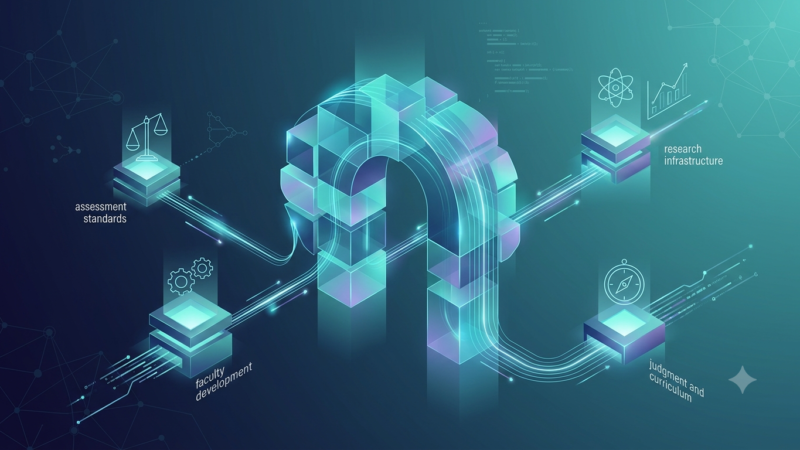
Two questions run beneath this week’s AI signals: whether institutions can keep assessment standards consistent, and whether their faculty, curriculum, and computing infrastructure are ready for the work AI now demands.
Two questions run beneath this week’s AI signals: whether institutions can keep assessment standards consistent, and whether their faculty, curriculum, and computing infrastructure are ready for the work AI now demands.

As AI makes finished products weaker proof of learning, institutions are redesigning assessment around evidence of thinking, while AI fluency spreads well beyond computer science.

As faculty prepare for a new academic year, higher education is retiring AI detectors and facing a harder question: how to prove students actually learned. This edition covers the shift from detection to evidence of learning, OpenAI’s new role-specific education plugins, and the widening gap between AI adoption and governance.
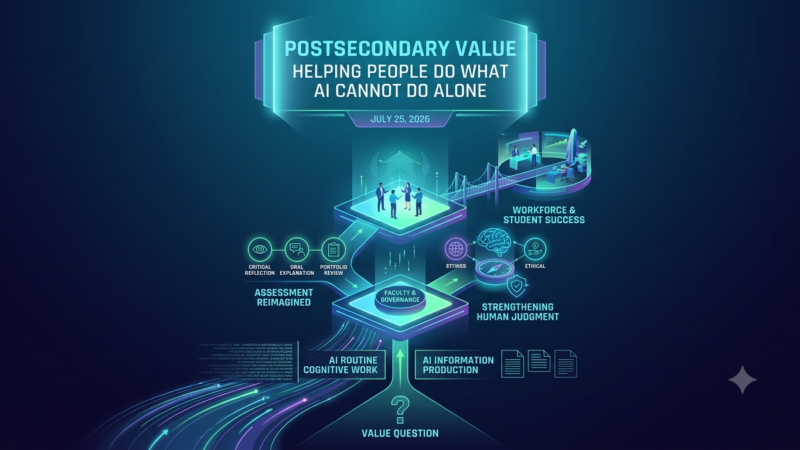
Two tensions defined the week in higher education and AI: a sharpening question about what a degree is worth, and a widening gap between AI access and the governance, faculty preparation, and assessment design needed to use it well. This edition covers the Ithaka S+R value brief, a 156,135-student study on AI and grades, and new AI degree programs from Chicago to South Dakota.
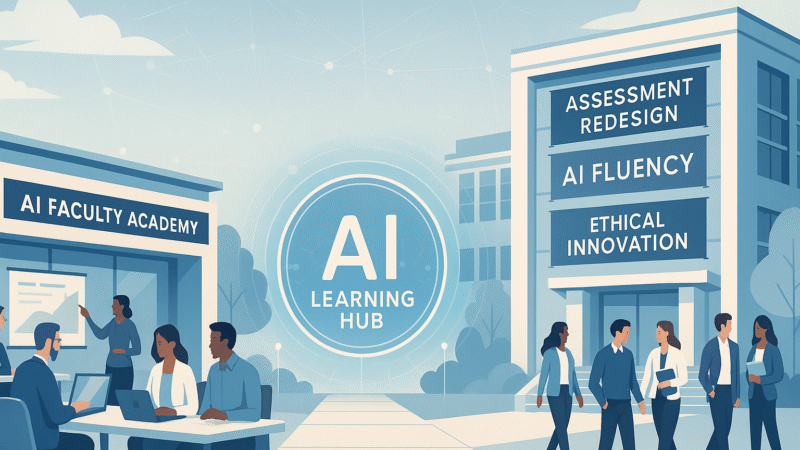
AI in higher education is no longer an experiment—it’s becoming the backbone of equitable learning systems. From California’s statewide AI tutoring program to global reforms in assessment and adult learning, colleges are redefining innovation around access, ethics, and educator leadership. This issue spotlights how faculty-led AI literacy and thoughtful policy are shaping a future where technology expands opportunity rather than replacing human connection.

As AI moves from pilot projects into everyday tools, real progress depends on faculty capacity. This piece centers instructors co-designing rubrics, syllabus policies, and course workflows—paired with LMS/Workspace integrations and emerging research infrastructure—so platforms amplify learning, integrity, and scholarship rather than replace human judgment.