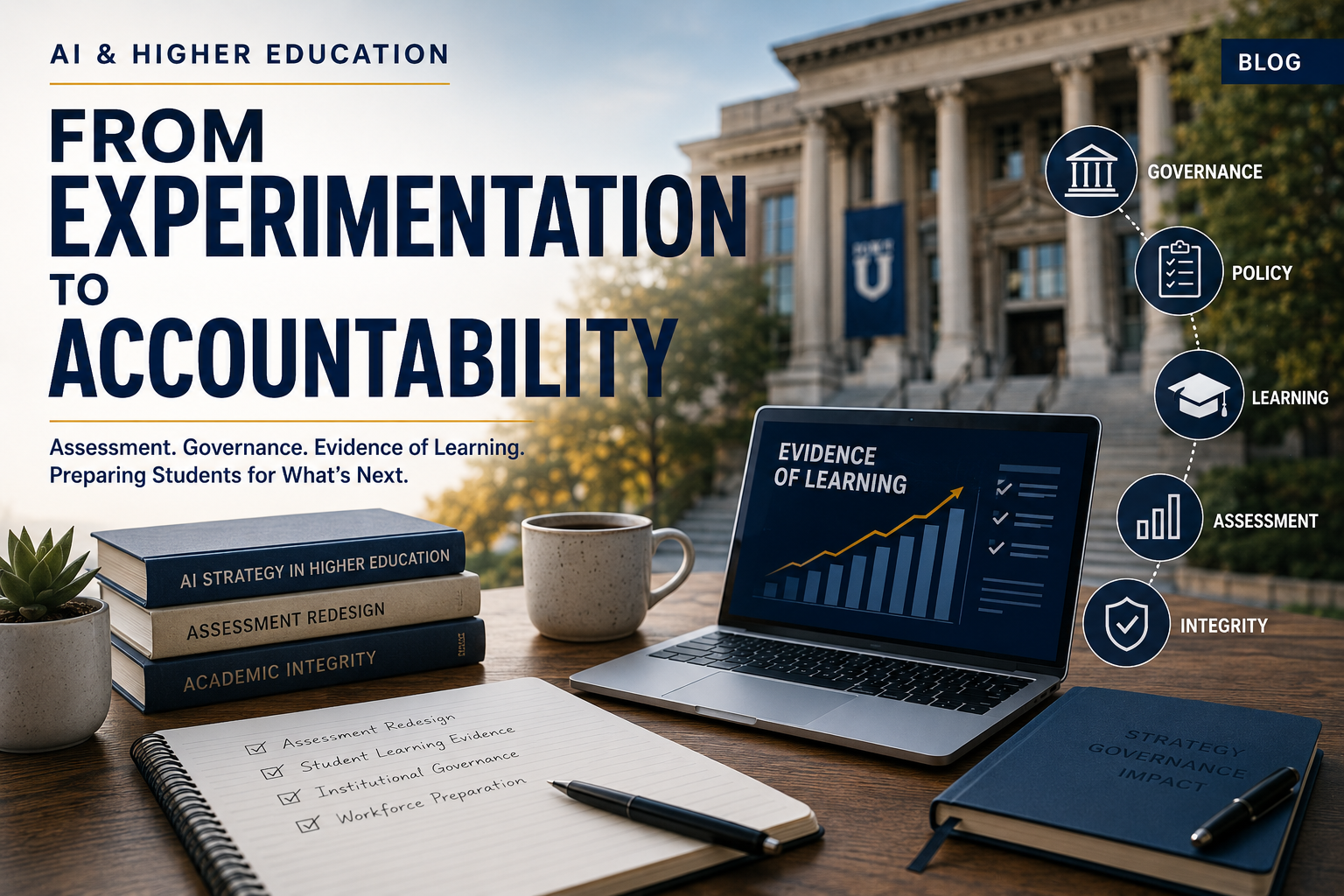
This week’s strongest pattern was the shift from AI experimentation to institutional accountability. The conversation moved beyond whether AI belongs in higher education toward who governs it, how learning is assessed, and what evidence institutions can provide that students are actually developing disciplinary competence.A second tension centered on the widening gap between student behavior and institutional readiness. Students continue adopting AI faster than universities can establish coherent policies, assessment models, workforce-preparation strategies, and faculty support structures. The result is growing pressure on leadership teams to move from fragmented responses to institution-wide strategy.
“Universities are supposed to develop critical thinkers.”
— Professor Sam Illingworth, Higher Education Policy Institute (Illingworth, 2026)
Executive Alert
Assessment integrity has become the defining strategic issue of the AI era. This week’s Science study—drawn from 95,513 students across 20 U.S. public research universities—concluded that widespread generative AI use and misuse require assessment reform rather than reliance on blanket detection systems or universal restrictions. The findings elevate assessment redesign from a faculty concern to an institutional leadership priority.
Featured News
Assessment Reform Emerges as Higher Education’s Central AI Challenge
A major Science study found substantial variation in generative AI use and misuse across disciplines, suggesting institutions should pursue discipline-specific assessment redesign rather than broad AI enforcement. Traditional assignment structures grow increasingly vulnerable when learning is measured through final products rather than demonstrated reasoning.
The Details
Researchers analyzed survey responses from 95,513 students across 20 public research-intensive universities, concluding that assessment validity, disciplinary context, and learning design demand more attention than AI detection alone.
Why It Matters
The institutions that adapt fastest will redesign how learning is demonstrated, documented, and evaluated. This is now an academic-strategy issue, not merely an academic-integrity issue—and the cost of waiting is degraded evidence of learning across entire programs.
HEPI Study Finds Many University AI Policies Operate More Like Enforcement Systems
A Higher Education Policy Institute review of 96 university AI policies found that many present themselves as educational frameworks while functioning primarily as detection-and-discipline systems. The study also found that 41% of UK degree-awarding institutions lacked a publicly accessible AI policy.
The Details
The report examined policy accessibility, structure, and institutional framing, finding significant variation and concluding that policy placement often determines whether AI is treated as a learning issue or a misconduct issue.
Why It Matters
Policy language shapes campus culture. Institutions that frame AI primarily through disciplinary mechanisms may face greater student and faculty resistance than those integrating AI into teaching and learning strategy—and accessibility itself signals intent.
More From This Week
Do It Now Checklist
- Audit whether your institutional AI policy is primarily educational, operational, or disciplinary in practice—and where it physically lives on your site.
- Identify one high-enrollment course where assessment redesign should become an immediate priority this term.
- Require each academic unit to define acceptable, limited, and prohibited AI uses in writing.
- Test whether students can locate AI guidance in under 60 seconds without navigating multiple systems.
- Assess faculty workload implications tied to AI policy enforcement before mandating it.
- Stand up a cross-functional AI governance group spanning faculty, academic affairs, student affairs, IT, and legal.
- Align AI initiatives with workforce-readiness outcomes rather than tool adoption alone.
Join the Conversation: What is the greatest obstacle preventing your institution from moving from AI experimentation to AI governance, assessment redesign, and workforce preparation?
Betting On: Assessment Redesign
This week reinforced a reality many institutions have tried to postpone. AI is not primarily disrupting technology strategy. It is disrupting the evidence of learning.
The universities that thrive will not be those with the most tools. They will be the institutions that redesign assessment, clarify expectations, support faculty, and build governance structures students can trust.
With Inspiration Moments, we share motivational nuggets to empower you to make meaningful choices for a more fulfilling future. Betting on assessment redesign means protecting the value of learning before defending the appearance of control.
Stay mindful, stay focused, and remember that every great change starts with a single step. So, keep thriving, understanding that Life happens for you.