
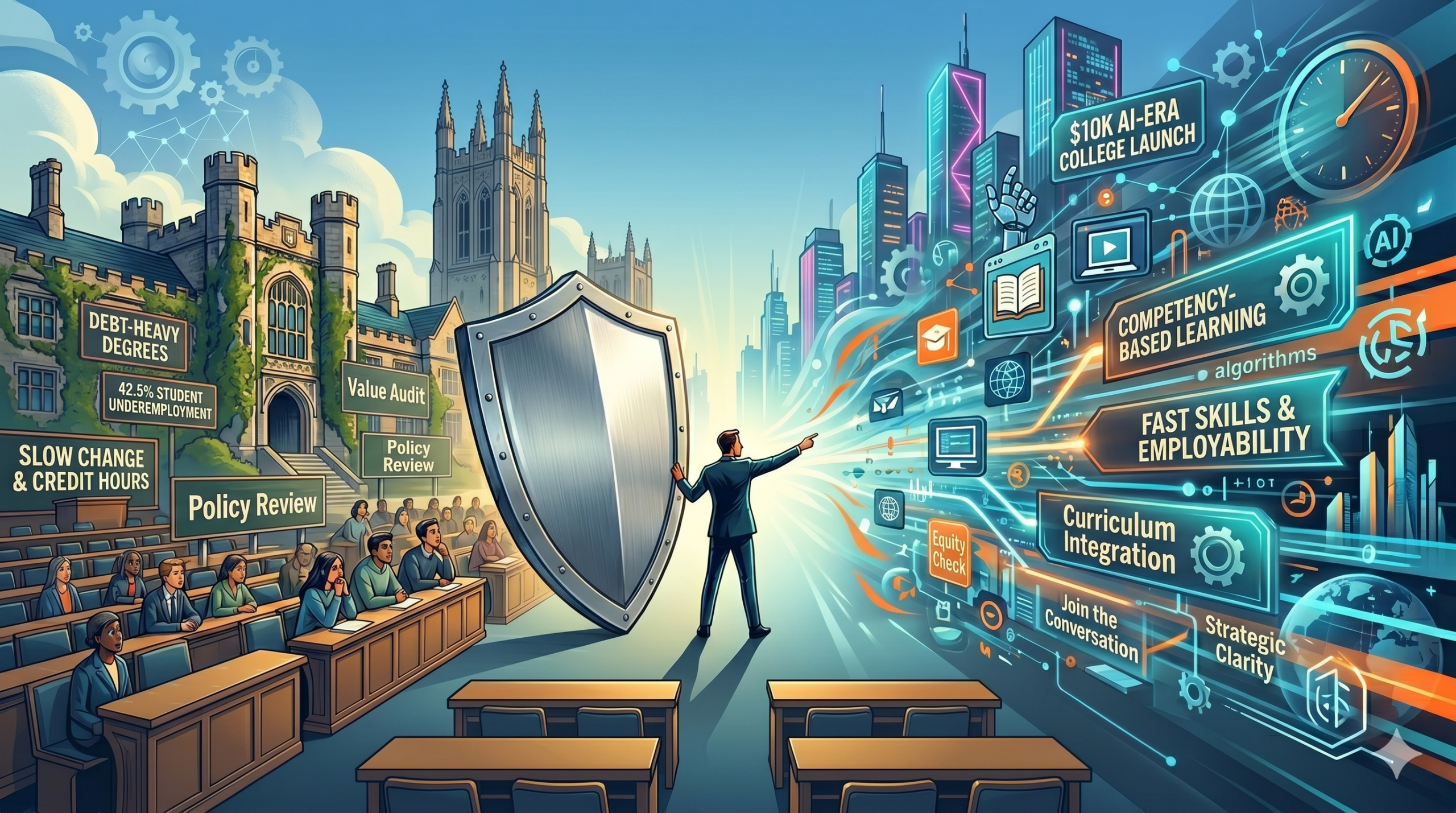
Higher education is no longer just managing AI adoption — it is defending its value proposition against AI-native competitors. This week, the convergence of a $10K AI-era college launch, rising student underemployment at 42.5%, growing legal risk from detection tools, and a global summit demanding institutional coherence signals a pivotal moment. The question is no longer whether AI will reshape higher education. The question is whether traditional institutions will quickly enough reshape themselves to remain relevant. Strategic clarity is no longer a luxury for planning committees; it is the primary requirement for survival in a market where the cost of knowledge delivery is rapidly approaching zero.
AI is not waiting for committees. It is moving through classrooms, boardrooms, and now the marketplace, and institutions that cannot define their value will lose the argument by default.
— Lynn F. Austin, MBA
The $10K AI-Era College Challenge
The announcement of the Khan TED Institute on April 14, 2026, represents a fundamental shift in the competitive landscape. By combining Khan Academy’s mastery-based pedagogy, TED’s global intellectual reach, and ETS’s assessment infrastructure, this new entity offers a $10,000 degree designed specifically for an AI-present world. This model operates on three critical pillars: it is competency-based rather than time-based, emphasizes human communication skills, and uses AI-supported personalized learning pathways. This directly challenges the incumbent institution’s reliance on credit hours and traditional seat time. When lower-cost alternatives with globally recognized partners enter the market, traditional universities must articulate what they provide that cannot be easily replicated—specifically, the depth of community, mentorship, and high-stakes intellectual rigor that digital platforms often struggle to sustain at scale.
Underemployment and the Erosion of Entry-Level Work
Data presented at the ASU+GSV Summit in April 2026 revealed a sobering reality: student underemployment has climbed to 42.5%. This trend is driven by AI’s rapid absorption of routine entry-level tasks such as basic research, data synthesis, and routine analysis. Consequently, employers now expect new graduates to possess both AI fluency and the strategic thinking skills typically associated with mid-level roles. Internships are pivoting from task execution toward project-based AI management. As ASU Vice Provost Sukhwant Jhaj noted, “Work must live inside the curriculum, not at the end of it.” For institutions, this means the traditional separation between academic theory and professional practice is no longer tenable. Career readiness must be embedded as a foundational element of every degree program, ensuring students can pilot AI tools rather than being replaced by them.
Policy and Governance: Navigating Legal and Equity Risks
Institutional governance is currently facing a dual crisis of legal liability and policy inconsistency. As AI detection tools are increasingly challenged in court, universities are finding that “technical evidence” of AI use often fails to meet due-process standards. These tools disproportionately flag neurodivergent students and non-native English speakers, creating significant equity concerns. In response, the New York City DOE has established a framework where AI can assist in planning but cannot determine grades or disciplinary actions. This movement toward human-in-the-loop governance is becoming the gold standard. Institutions must move away from ad hoc responses and toward formal AI policies that prioritize evidence standards, equity vetting for all deployed tools, and clear definitions of acceptable use for both students and faculty.
Programs, Research, and Future Infrastructure
Leading institutions are aggressively investing in the structural changes required for this new era. Stanford University recently launched $1 million in seed grants through its Accelerator for Learning to fund course development that rethinks pedagogy from the ground up. Simultaneously, the University of Florida’s AI2 Summit highlighted that as automation handles routine knowledge delivery, universities must double down on judgment and critical thinking. This sentiment was echoed by MIT SHASS Dean Agustín Rayo, who argued that the humanities are “not optional” but, in fact, the most valuable fields for developing the moral compass and judgment that AI lacks. Furthermore, validating the FALCON-AI scale provides a much-needed framework for measuring faculty AI literacy, enabling provosts to move from general awareness to measurable institutional readiness.
Teaching and Learning: The Trust Vulnerability
The gap between student behavior and institutional policy continues to widen. While 64% of students report using AI to help them understand difficult concepts, many express deep anxiety about being wrongly accused of cheating. This trust deficit is forcing an acceleration of assessment redesign. Faculty are returning to oral exams, handwritten assignments, and process-based grading to ensure academic integrity. However, this shift raises a new question: Does a heavy dependence on AI during the learning process weaken a student’s long-term analytical depth? Educators are now tasked with balancing the efficiency of AI assistance with the need to maintain “cognitive struggle,” which is essential for true mastery. Trust and fairness are no longer just ethical considerations; they are central to the institutional value proposition.
Do It Now Checklist
Join the Conversation
Is your institution ready to articulate — in one sentence — why a motivated student should choose you over a $10K AI-native alternative? And are your detection practices defensible against both legal challenge and equity scrutiny?
Betting On: Strategic Clarity
This week’s stories converge on a single strategic reality — AI is not only changing classrooms, it is changing the competitive landscape of higher education itself. Institutions that can clearly explain their value, align their faculty, and redesign learning for an AI-present world will stabilize and grow. Those that delay will continue reacting to disruptions they could have anticipated. With Inspiration Moments, we share motivational nuggets to empower you to make meaningful choices for a more fulfilling future. This week, take one hour to write down what your institution does that AI cannot replicate — and let that answer guide every strategic decision you make this month. Stay mindful, stay focused, and remember that every great change starts with a single step. So, keep thriving, understanding that Life happens for you, not to you, to live your purpose. Until next time. Respectfully, Lynn “Coach” Austin.