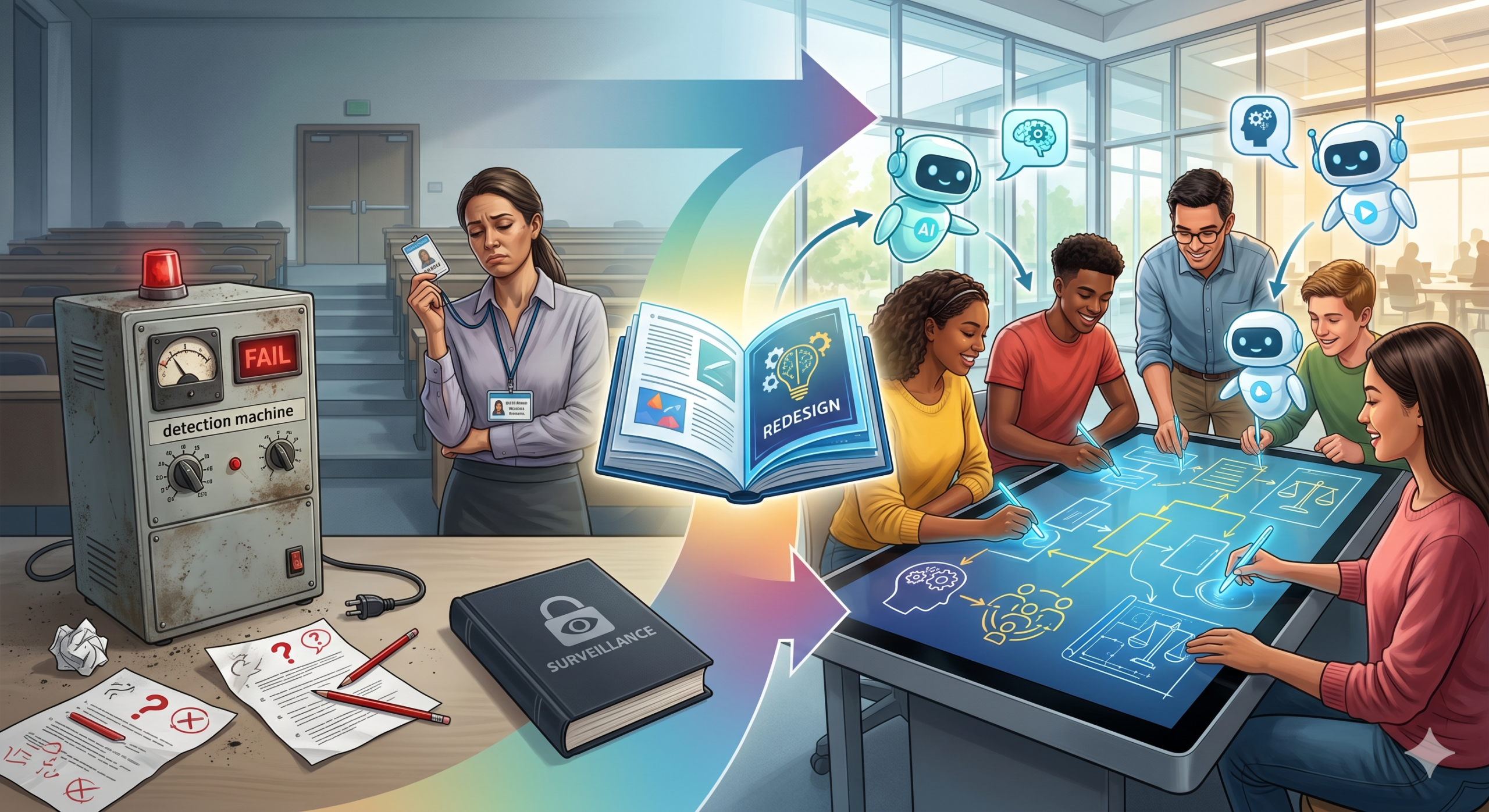
Higher education is moving past the debate over AI use and facing a more pressing reality, many traditional assignments no longer measure real learning. This issue reflects a clear shift away from unreliable detection tools and toward redesigning how students demonstrate thinking, judgment, and understanding.
Institutions are replacing surveillance with stronger assessment design. The focus is now on process, critique, and applied reasoning, often with AI as part of the workflow, not something to avoid. This is not a minor adjustment, it is a structural reset in how rigor and academic integrity are defined

Category: Digital Transformation
The “wild west” era of AI in higher education is officially over. In this week’s Global Brief, we explore the sector’s critical shift into the “Auditing Era.” Discover why universities are demanding “glass-box” transparency over commercial black-box models, actively auditing algorithms for bias, and legally fortifying their digital infrastructures. Read the top 10 stories shaping AI accountability and the future of the academy right now.
As institutions move beyond experimentation and into accountability, the question is no longer whether to use AI, but how to integrate it responsibly. This episode examines why speed without process creates resistance, how bypassing shared governance erodes trust, and why faculty leadership remains central to sustainable AI readiness.
Drawing on global guidance, accreditation expectations, and real institutional examples, Lynn and Angelina discuss the shift toward formal AI governance frameworks, clearer decision rights, and faculty development focused on judgment, ethics, and instructional alignment, not technical shortcuts.
As higher education moves beyond AI experimentation, a sharper tension is emerging between speed and stewardship. This week’s Global Brief examines how institutions are slowing down to address governance gaps, faculty trust, and accountability as AI shifts from pilot projects to embedded academic practice. The message is clear: sustainable AI readiness depends less on rapid deployment and more on clear decision rights, shared governance, and faculty-led academic integrity.
The first month of 2026 has concluded with a definitive signal that the “pilot phase” of AI in higher education is over. The narrative has shifted from individual experimentation to high-stakes infrastructure and governance. As evidenced by the launch of…
Higher education is entering a moment where decisions about AI use can no longer be put off or brushed aside. Leaders are confronting real pressure to define what responsible adoption looks like when policy gaps, equity concerns, and teaching quality…
This week’s AI & Higher-Education Global Brief explores how universities are moving from experimentation to accountability. Featured research highlights a growing demand for governance frameworks that balance innovation with integrity. From faculty readiness and AI-tool adoption to student writing and accreditation reform, the focus is shifting toward strategy, not novelty. Institutions are now being called to demonstrate measurable responsibility in how AI shapes teaching, learning, and policy—signaling a defining moment for higher education’s digital maturity.