
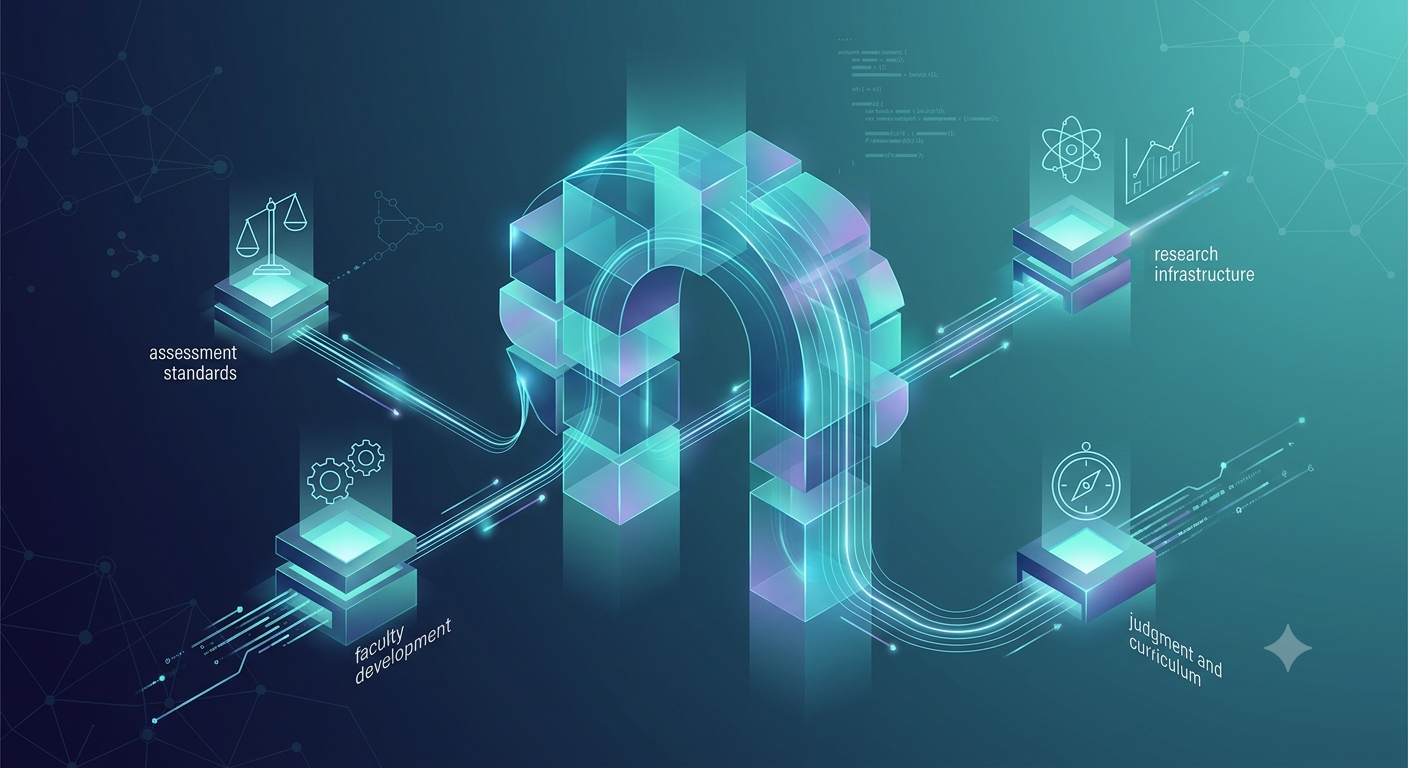
Across the past week, two questions kept surfacing beneath the daily AI signals. The first is consistency: institutions broadly agree that generative AI requires changes to assessment, yet faculty, departments, and programs are still applying very different rules, leaving students with uneven expectations and faculty with uneven responsibility. The second is capacity: AI is moving into research infrastructure, curriculum, workforce preparation, and faculty development at the same time, forcing institutions to decide whether their people, computing resources, and academic structures are actually ready for the work. The pattern this week is less about another new tool and more about what higher education must build around AI: clearer evidence of learning, infrastructure that can carry AI-intensive scholarship, curriculum that pairs technical capability with judgment, and faculty preparation connected to real teaching.
“AI readiness is no longer measured by the tools an institution adopts. It is measured by what that institution can actually support: consistent standards, prepared faculty, relevant curriculum, and infrastructure equal to the work.”
— Dr. Lynn Austin
QAA warns of a “perfect storm” as AI exposes uneven assessment
The Details
Generative AI is surfacing substantial variation in assessment practice across higher education. QAA’s new State of the Nation report finds the differences are not only between universities; students can meet conflicting rules and expectations within the same institution, depending on program, module, or instructor (Donaghy & Robinson, 2026). The analysis draws on recent studies of generative AI in higher education, QAA review findings, and spring roundtables with staff and students. It distinguishes useful pedagogical variation from inconsistency caused by unclear policy or uneven faculty preparation, and notes that staff confidence and student access to AI tools both remain uneven. Those differences become a quality and standards problem, the authors argue, when they produce materially different learner experiences without educational justification.
Why it Matters
This is where faculty autonomy and institutional responsibility have to be reconciled. A biology lab, a business case analysis, a doctoral dissertation, and a first-year composition assignment should not carry identical AI rules; at the same time, students should not face a patchwork of unexplained expectations. The practical answer is institution-wide principles, clear assignment-level guidance, and faculty development that allows disciplinary judgment without producing arbitrary differences in standards.
New evidence map: generative AI is not one educational intervention
The Details
A peer-reviewed study published August 8 in Quality & Quantity examined how generative AI is being positioned across higher education practice. Rather than one dominant model of adoption, Erdem Aksoy found that AI is used through different pedagogical functions across disciplines, with assessment and feedback the most common focus and clear differences in secondary uses between fields (Aksoy, 2026). The study uses a theory-informed hybrid bibliometric evidence-mapping approach across a corpus of nearly 1,700 publications, and connects those disciplinary differences directly to curriculum design and instructional strategy. It was accepted July 29 and published as the version of record on August 8, 2026.
Why it Matters
Institution-wide AI strategy should set common expectations for ethics, transparency, privacy, and academic standards, but it should not assume every discipline teaches or assesses AI the same way. For faculty development, this is an argument against generic “how to use AI” workshops as the primary model. Faculty need discipline-specific examples that connect AI use to learning outcomes, professional practice, assessment, and the judgment students are expected to develop.
Policy & Governance
-
Research computing becomes an AI talent and competitiveness issue
EDUCAUSE Review argues that universities risk losing AI-intensive researchers when their computing infrastructure cannot support modern workloads. Steven Goodman, Senior Director of Technology at Marquette University, notes that AI research demand goes well beyond buying a few GPU servers: large-model training, genomic computation, high-resolution imaging, and real-time simulation expose limits in power, cooling, networking, storage, and research-computing architecture (Goodman, 2026). He points out that a rack of current AI accelerators can draw 60 to 100 kilowatts, against the 5 to 15 kilowatts traditional academic data centers were built around, which makes this a facilities and power question as much as an IT one. For presidents, provosts, research leaders, and CIOs, AI infrastructure is becoming part of faculty recruitment, research capacity, grant competitiveness, and graduate education, not simply a capital request.
-
Utah opens research funding tied to AI, including a $45 million pilot
The University of Utah announced information sessions for two new state-backed funding efforts established through HB 373. The Utah AI Moonshot Program is a $5 million initiative for pro-human AI projects, awarding grants from $50,000 up to $1 million. Separately, the Higher Education Research Funding Pilot is a multi-year $45 million competitive program supporting high-impact research across a range of strategic fields, including artificial intelligence alongside biotechnology, quantum computing, advanced robotics, and others (University of Utah, 2026). Town halls were scheduled for early and mid-August, with letters of intent due August 17. The signal for other systems is worth watching: AI research strategy is increasingly tied to coordinated public investment and the ability to build interdisciplinary teams around large funding opportunities.
Programs, Research & Infrastructure
-
City Colleges of Chicago launches its first credit-bearing AI degree
City Colleges of Chicago announced an Associate in Applied Science in Artificial Intelligence and Machine Learning Development at Wilbur Wright College on August 5. The program is built to prepare students to design, build, train, and deploy AI and machine-learning systems, with coursework spanning data processing, supervised and unsupervised learning, neural networks, deep learning, model deployment, natural language processing, computer vision, and ethics in technology, and it explicitly connects curriculum to workforce demand (City Colleges of Chicago, 2026). Provost and Chief Academic Officer Dr. Mark Potter said the launch “reflects City Colleges of Chicago’s continued commitment to aligning academic programs with workforce needs.” The community-college setting matters: AI education is expanding beyond four-year computer-science and graduate programs into more accessible workforce pathways that reach students seeking shorter, lower-cost routes into technical careers.
-
William & Mary pairs computer science and philosophy in a new AI & Ethics minor
William & Mary introduced an interdisciplinary AI & Ethics minor drawing on its computer science and philosophy departments, offered through the College of Arts & Sciences and the School of Computing, Data Sciences & Physics (Argel, 2026). Faculty describe the goal as helping students understand both how AI works and how to evaluate its human and ethical implications. The program is a useful model for institutions that do not want AI education reduced to technical proficiency: graduates who will use AI in business, healthcare, government, and education also need frameworks for weighing values, consequences, and responsible decisions.
-
Washington State University launches a master’s degree in artificial intelligence
Washington State University announced on August 3 that its new master’s degree in artificial intelligence is getting underway this fall in the School of Electrical Engineering and Computer Science, with a curriculum built to provide advanced AI and machine-learning skills aligned with industry demand (Washington State University, 2026). Graduate AI programs continue to expand as universities respond to demand for advanced technical skills. The strategic question is whether these programs stay current as tools change while still teaching durable foundations that outlast any one generation of models or platforms.
-
Texas A&M-Central Texas turns vendor training into institution-wide development
Texas A&M University-Central Texas reported on August 7 that 26 faculty and staff members took part in Google AI Higher Education Summits held across the country, and that it deliberately included participants from academic disciplines, administration, instructional support, and student services (Clos, 2026). The institution is using the experience to extend AI learning on its own campus. The noteworthy element is the train-the-institution approach: vendor events have limited value if knowledge stays with a few attendees, and translating external training into local faculty development, implementation resources, and cross-functional discussion is far more likely to build lasting capacity.
-
National University of Singapore puts deep learning ahead of tool use
The National University of Singapore’s AI Centre for Educational Technologies reported faculty-focused activities on August 5 and 6, including a session on sustaining deep, meaningful learning in the presence of generative AI and a hands-on workshop for language faculty using its ScholAIstic platform (National University of Singapore AI Centre for Educational Technologies, 2026). The work reflects a broader international pattern: universities are connecting AI tool development with pedagogy and discipline-specific faculty preparation rather than treating technology demonstrations as the endpoint.
-
Syllabus study maps what AI-assisted software engineering courses actually teach
Researchers from UC San Diego, the University of Auckland, Aalto University, and collaborating institutions analyzed 23 upper-division U.S. course syllabi that explicitly incorporate generative AI into software-engineering work. The August 6 preprint finds that institutions are beginning to treat AI-assisted development as a curricular subject in its own right, with implications for learning objectives, assessment, tools, workflows, and professional judgment (Geng et al., 2026). The study moves the conversation past whether students should use coding assistants: software-engineering programs now have to define what competence means when AI-assisted coding, debugging, testing, and documentation are part of professional practice. It is a preprint and should be treated as emerging evidence rather than peer-reviewed findings.
Do It Now Checklist
Betting On: Institutional Capacity
This week’s strongest signal is that AI readiness is becoming measurable in what institutions can actually support: consistent academic standards, prepared faculty, relevant curriculum, and research infrastructure equal to the work. Betting on institutional capacity means making sure the people, policies, curricula, and infrastructure are ready before expectations outrun what the institution can responsibly deliver.
With Inspiration Moments, we share the reminder that meaningful progress is built one deliberate choice at a time. Stay focused on what you can build now, keep betting on the capacity you are creating, and remember that “Life happens for you, not to you, to live your purpose.”
Respectfully,
Dr. Lynn Austin