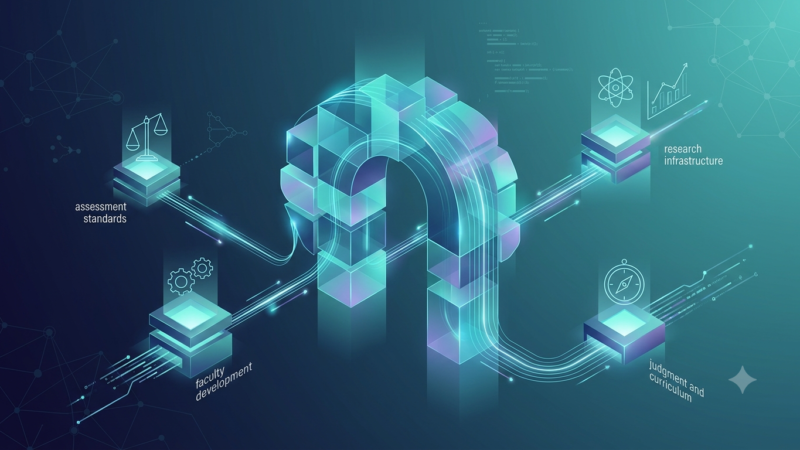
Two questions run beneath this week’s AI signals: whether institutions can keep assessment standards consistent, and whether their faculty, curriculum, and computing infrastructure are ready for the work AI now demands.
Two questions run beneath this week’s AI signals: whether institutions can keep assessment standards consistent, and whether their faculty, curriculum, and computing infrastructure are ready for the work AI now demands.

As faculty prepare for a new academic year, higher education is retiring AI detectors and facing a harder question: how to prove students actually learned. This edition covers the shift from detection to evidence of learning, OpenAI’s new role-specific education plugins, and the widening gap between AI adoption and governance.

This week’s AI & Higher-Education Global Brief highlights a decisive shift from experimentation to institutionalization. Across campuses, leaders are confronting mounting governance pressure, faculty workload strain, and assessment integrity concerns as AI adoption accelerates. The stories reveal a clear pattern: sustainable integration now depends less on tool deployment and more on policy clarity, infrastructure maturity, and faculty capacity building.

As higher education moves beyond AI experimentation, a sharper tension is emerging between speed and stewardship. This week’s Global Brief examines how institutions are slowing down to address governance gaps, faculty trust, and accountability as AI shifts from pilot projects to embedded academic practice. The message is clear: sustainable AI readiness depends less on rapid deployment and more on clear decision rights, shared governance, and faculty-led academic integrity.

From free AI tools for students to ethical breaches in research and shifting faculty workloads, this week’s roundup reveals how higher education is both adapting to and helping shape the future of AI. The key? Responsible strategy, academic voice, and intentional leadership.