
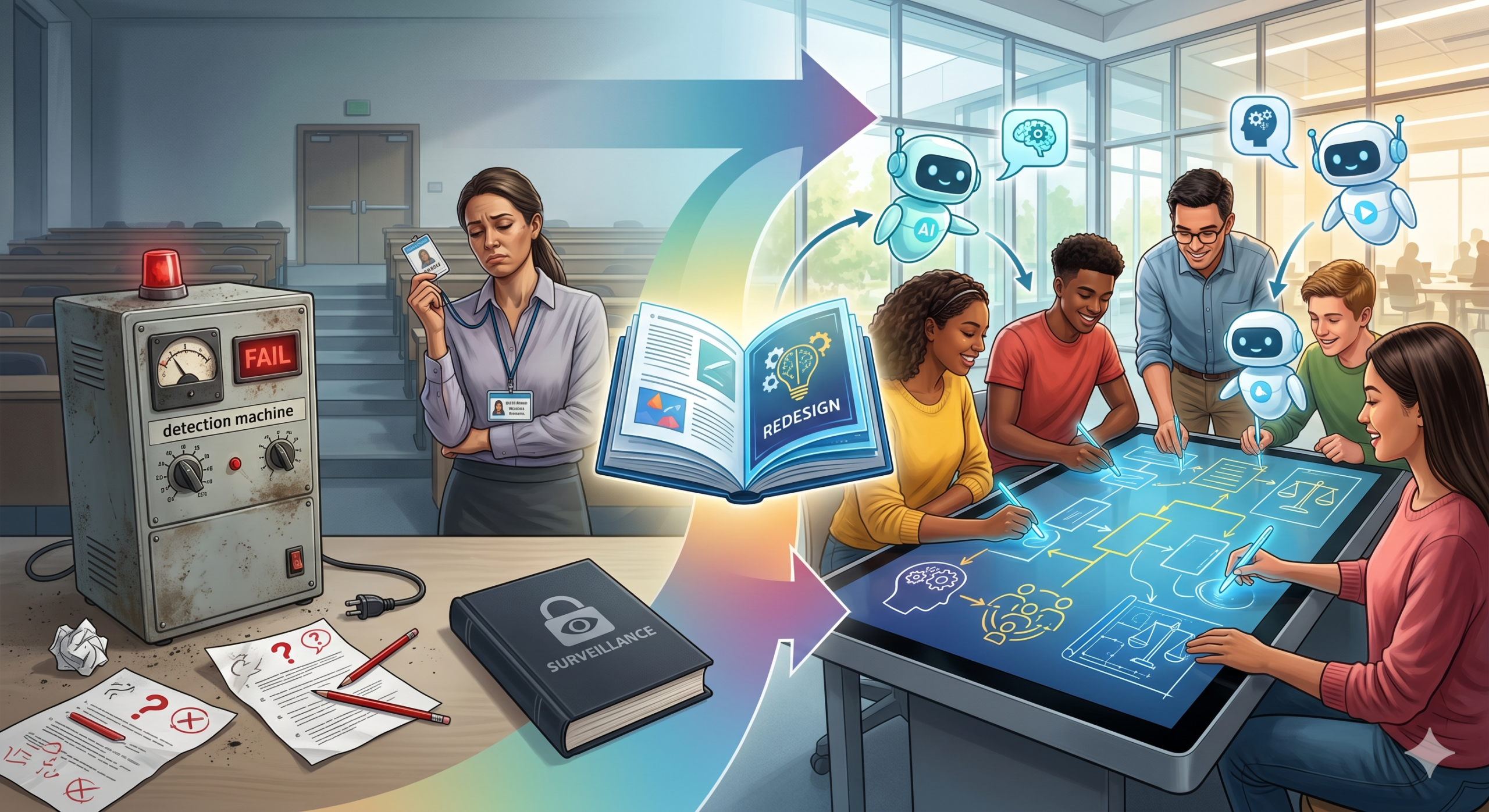
The higher education sector continues a profound and overdue pedagogical reckoning. The exhausting, high-stakes arms race of “AI detection” has been exposed for what it truly is: not only technologically broken, but educationally hollow. This week, sweeping global institutional data and landmark academic research are confirming a massive, irreversible pivot — we are officially walking away from policing AI outputs and throwing our institutional weight behind something far more powerful: redesigning the curriculum itself. Universities are waking up to a simple but radical truth: if an assignment can be effortlessly completed by a language model in seconds, the assignment — not the student — is what demands an upgrade. From the widespread abandonment of discredited detection software to the rollout of bold “AI-resilient” course design frameworks, the focus has shifted decisively toward teaching students how to think critically alongside these tools, rather than pretending the tools don’t exist — or worse, punishing students for using them.
We cannot detect our way out of a paradigm shift. True academic integrity in the AI era is not found in surveillance, but in the intentional redesign of our assessments to value human inquiry over standardized output.
— Lynn F. Austin, MBA
The Death of AI Detection in Academic Integrity
A landmark multi-institution study published in the Journal of Academic Ethics has ignited a national wave of university provosts formally directing faculty to stop using AI detection software for disciplinary actions — citing indefensible false-positive rates that fall hardest on the students institutions claim to serve most.
The Details
- Statistical Failure: The study delivered a damning verdict: even the most sophisticated detectors cannot reliably distinguish between heavily edited human writing and polished AI output, resulting in a staggering 22% false-positive rate among ESL students and essentially penalizing students for how they learned to write.
- Policy Shift: Over 40 R1 institutions rewrote their academic honor codes this week to explicitly prohibit AI detection scores from serving as the sole basis for academic misconduct charges — a direct acknowledgment that the tools were never fit for that purpose.
- Alternative Measures: The spotlight has shifted to “process tracking” — requiring students to submit prompt histories, draft versions, and oral defenses of their written work, centering learning over surveillance.
Why it Matters
This effectively closes the book on the “policing” era of generative AI in higher education. The energy and budget previously funneled into an unwinnable surveillance arms race must now flow into faculty development and assessment redesign — where the real work of education has always lived (Journal of Academic Ethics, 2026).
EDUCAUSE Releases “AI-Resilient Curriculum” Framework
Responding to a sector-wide cry for structural guidance, EDUCAUSE and the Association of American Colleges and Universities (AAC&U) co-published a long-awaited framework giving departments a concrete, systematic roadmap for auditing and upgrading their degree programs for the agentic AI era.
The Details
- Flipped Assessments: The framework champions bold “flipped assessment models” — where AI generates the first draft or initial code, and students are graded entirely on the quality of their critique, editing, and fact-checking of that output. The thinking replaces the typing.
- Programmatic Mapping: It delivers a practical toolkit for curriculum committees to trace exactly where AI literacy is introduced, practiced, and mastered across every year of a four-year degree — turning AI fluency from a buzzword into a measurable outcome.
- Faculty Workload: Critically, it confronts the elephant in the room head-on: operational strategies for deploying agentic AI to help faculty manage the heavier grading demands these personalized, process-oriented assessments will create.
Why it Matters
This is the first scalable, broadly endorsed blueprint to move AI from an isolated “tech add-on” into the very core of institutional curriculum strategy — handing faculty not just a vision, but a genuine roadmap for getting there (EDUCAUSE, 2026).
POLICY & GOVERNANCE
-
EUA Guidelines on Student IP and Generative Models
The European University Association (EUA) released stringent new guidelines requiring universities to implement “opt-out” mechanisms for students, preventing their submitted coursework from being used to train internal campus-wide language models without explicit, renewed consent (EUA, 2026).
-
Clarification on FERPA and “Agentic” Memory
The U.S. Department of Education issued a policy brief clarifying that AI agents with “persistent memory” features (retaining context across multiple student sessions) must meet the exact same data-silencing and privacy standards as traditional student record databases under FERPA (U.S. Dept. of Education, 2026).
-
State Mandates for Applied AI Literacy
Three additional states have passed legislation this week mandating that all public university systems establish a baseline “Applied AI Literacy” competency requirement for all graduating seniors by the 2027-2028 academic year, aligning degrees with evolving workforce demands (Chronicle of Higher Education, 2026).
PROGRAMS, RESEARCH & INFRASTRUCTURE
-
Local Open-Weights Models for Campus Research
The University of Michigan announced the successful deployment of a completely localized, open-weights LLM running entirely on campus servers, providing researchers with advanced generative capabilities while guaranteeing zero data leakage or IP exposure to commercial tech companies (University of Michigan Record, 2026).
-
ACRL Framework for AI in Literature Reviews
The Association of College and Research Libraries (ACRL) published new standards for graduate students and faculty, detailing methodologically sound practices for utilizing AI in literature scoping, systematic reviews, and meta-analyses while avoiding “hallucinated citations” (ACRL, 2026).
-
Automating the Administrative Load
A pilot program at Georgia State University revealed that deploying tightly governed agentic AI workflows for administrative tasks—such as processing transfer credits and generating advising summaries—reduced faculty administrative load by 18%, freeing up time for direct student mentorship (GSU News Hub, 2026).
OTHER
-
Triage Guidelines for AI “Therapy Bots”
In response to students increasingly turning to unregulated AI companions for mental health support, the American College Health Association (ACHA) released triage guidelines for campus counseling centers to help practitioners identify and assist students who rely on unsafe digital advice (ACHA, 2026).
-
Tracking the Campus “Compute Carbon Footprint”
A coalition of sustainability directors from 15 major universities launched an initiative to track and report the “compute carbon footprint” of enterprise AI use on campuses, arguing that massive LLM deployments are threatening institutional carbon-neutrality goals (Higher Ed Sustainability Journal, 2026).
Do It Now Checklist
Betting On: The Curriculum Pivot
This week’s developments leave no room for ambiguity: the era of detecting and policing AI in the classroom is finished. Our mandate now is the thoughtful, courageous, structural integration of these tools into how we teach, assess, and prepare students for the world they will actually inhabit. By trading surveillance for curriculum redesign, we stop treating students as suspects and start treating them as learners navigating the same technological reality we all face. With Inspiration Moments, we share motivational nuggets to empower you to make meaningful choices for a more fulfilling future. This week, release the impossible fantasy of policing the digital landscape and lean fully into the hard, rewarding, human work of reimagining how we teach and learn. Stay mindful, stay focused, and remember that every great change starts with a single step. So, keep thriving, understanding that ‘Life happens for you, not to you, to live your purpose.’ Until next time.
Respectfully,
Lynn “Coach” Austin